
Comparison
Why numerology calculators give different results
Compare inputs, positions, alphabets and reduction rules to find the first step where two numerology results split. Includes live, reproducible examples.
The short answer
Numerology calculators disagree when they do not answer the same question or do not use the same rules. The difference usually begins with the input, the profile position, the alphabet, the order of reduction, the treatment of 11/22/33, the letter Y, or the year selected for an annual cycle.
Do not start by choosing the result that feels more accurate. Put both calculations side by side and locate the first line that changes. Everything after that line may be internally consistent and still end at a different number.
Step-by-step diagnostic
Change one rule and find the first split
The examples are fixed and fictional. They are calculated locally by the same engine as the Numerus tools.
The same date, two different positions
- Held constant
- 1990-07-16
- Changed
- The result label
Life Path
A full-date position.
- Month
7= 7 - Day
1 + 6= 7 - Year
1 + 9 + 9 + 0= 19 - Year
1 + 9= 10 - Year
1 + 0= 1 - Component sum
7 + 7 + 1= 15 - Final reduction
1 + 5= 6
Birthday Number
A day-only position.
- Birthday
1 + 6= 7
First divergence: Life Path uses month, day and year. Birthday Number uses only day 16.
The seven checks, in the right order
1. Confirm the exact input
Compare what each calculator actually received, not what you intended to enter. For a date, check day, month and year, especially on sites that switch between DD/MM/YYYY and MM/DD/YYYY. A calendar-validity check should happen before the numerology calculation. For a name, compare every included word, initial and suffix.
Separators are not always meaningful. Numerus ignores spaces, hyphens and apostrophes when summing letters, but it does not invent a missing name part. Ana-Maria and Ana Maria therefore use the same letters here. Ana and Ana Maria do not.
2. Check the position label
A number is not identified by its final digit alone. Life Path, Birthday Number, Expression, Soul Urge, Personality and Maturity begin from different inputs. Two results can both be correct under the same method if one is Life Path and the other is Birthday Number.
This is the quickest mismatch to resolve. Copy the complete label beside each result before comparing arithmetic. If one site says “destiny number,” inspect its method to see whether it means Expression or something else.
3. Identify the system and alphabet
The word “numerology” does not name one universal calculation system. Western and Chaldean name methods assign some letters differently. Lo Shu and psychomatrix approaches begin from a date grid rather than the same A–Z sum. A result from one system should not be expected to match another.
Ask for the alphabet table. If a method page does not show one, you cannot reproduce a name total from the result alone. Our systems comparison holds the declared input steady and shows which operation changes.
4. Follow the order of reduction
Even when two calculators use the same letter values, they may group the arithmetic differently. One may sum all letters and reduce once. Another may reduce each name part, then add the reduced parts. If an intermediate subtotal is 11, 22 or 33, the grouping decision can change the final value.
Write the subtotals on separate lines. “Same letters” is not enough. You need the same grouping and the same stopping rule too.
5. Mark every master-number stopping point
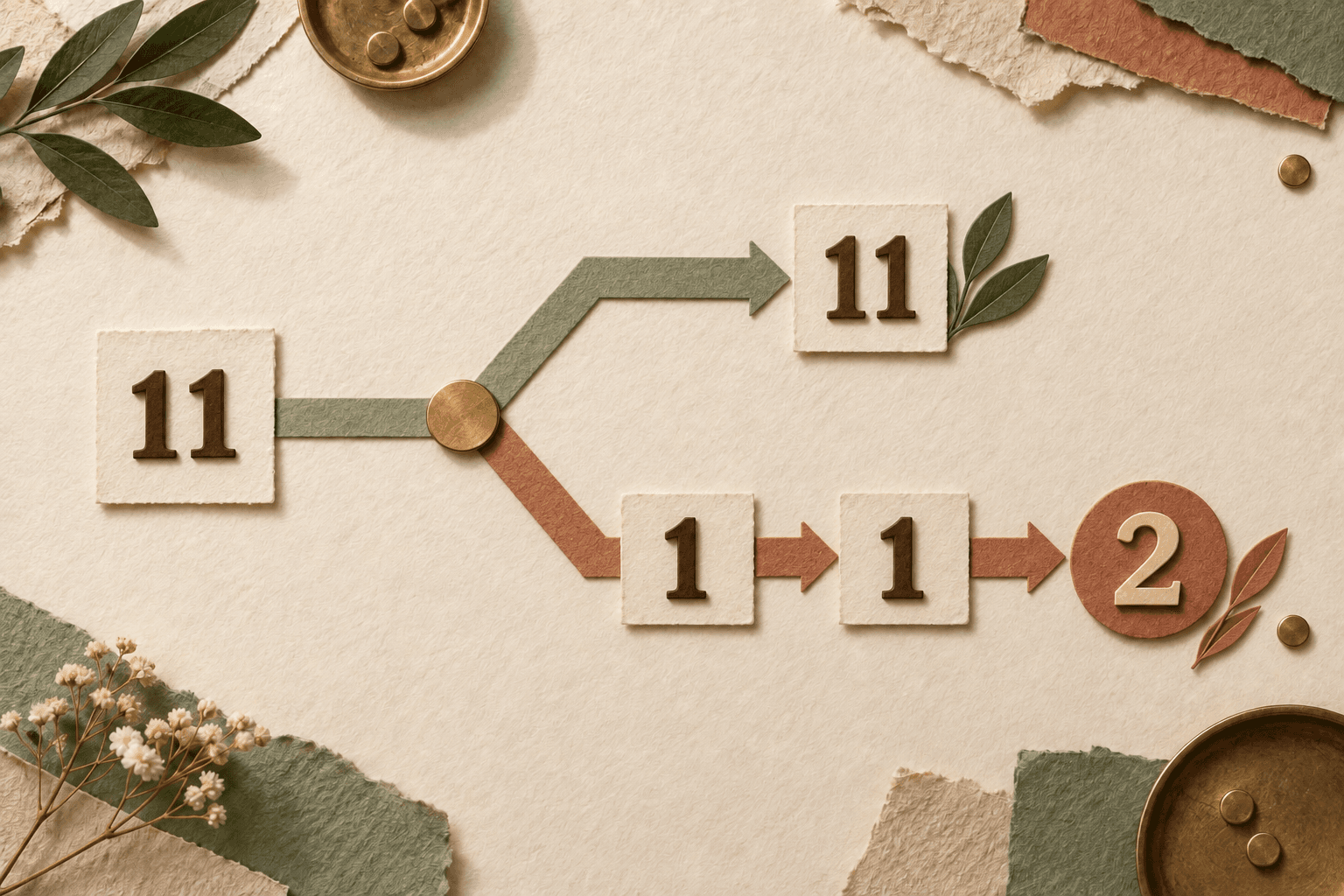
Some methods retain 11 and 22. Others also retain 33. Some preserve them only in selected profile positions, while annual cycles continue to a single digit. This creates familiar pairs such as 11/2, 22/4 and 33/6.
Circle the first 11, 22 or 33 in both calculations. Then ask whether each method stops there. The interactive example above uses the same subtotal 11 to make that one decision visible. The master-number guide explains the full Numerus convention.
6. Inspect Y, diacritics and transliteration
Numerus normalizes Romanian diacritics to their A–Z equivalents: ȘTEFAN becomes STEFAN, and both spellings therefore produce the same letter values. Other Latin diacritics may also decompose, but a non-Latin script is not automatically transliterated. The calculator shows a warning rather than silently choosing a spelling.
Y is a convention, not a technical error. In western-v1, Y is always a consonant. Another method may classify it as a vowel according to sound or position. The first divergence then appears in Soul Urge and Personality, even if Expression remains unchanged because all letters still contribute there.
7. Check the year and annual convention
A Personal Year uses the month and day of birth plus the year being examined. It does not add the birth year as the target year. Selecting 2025 asks a different question from selecting 1990.
Numerus reduces annual cycles to 1–9. A subtotal of 11 therefore becomes 2 in this calculation, even though an eligible profile position may retain 11. The Personal Year guide shows the complete rule and lets you select a year without creating a separate prediction page for it.
A five-minute comparison checklist
Use this without entering your data into another service. Keep the two existing result screens or written calculations beside you.
- Copy the exact input shown by each calculator.
- Copy the full result label, not only the number.
- Note the named system and its alphabet table.
- Write each visible subtotal in order.
- Mark where 11, 22 or 33 first appears and whether reduction stops.
- For names, compare included words, normalized letters, Y and transliteration.
- For annual cycles, confirm the selected calendar year.
- Stop at the first difference. That is the cause to explain before looking at later totals.
If a calculator shows only a final number, the missing steps are themselves the limit. You may be able to reproduce the Numerus side through the worked examples, but you cannot infer another site's hidden choices with certainty.
What a mismatch does and does not tell you
A mismatch can show that two methods use different conventions. It does not, by itself, prove that one interpretation describes you better. Arithmetic can be reproducible once the rules are declared; the symbolic meaning is a separate question.
Numerus does not score or rank external calculators. The useful comparison is narrower: same input, same position, same alphabet, same order and same stopping rule. When those match, the arithmetic should match too. If it does not, a visible step is missing or an implementation error is worth reporting.
To inspect every Numerus rule, use the modern Western method. To test a date and optional name privately, open the complete profile calculator. Inputs remain in your browser.